May 2026
© IKI-Hub Indonesia Communications Team
Across much of the world’s biodiversity discourse, young people are increasingly positioned as major actors in determining whether ecological protection can be sustained across generations. In Indonesia, where environmental pressures continue to intersect with rapid urbanisation and development, strengthening ecological literacy among younger generations has become inseparable from the broader question of biodiversity governance itself.
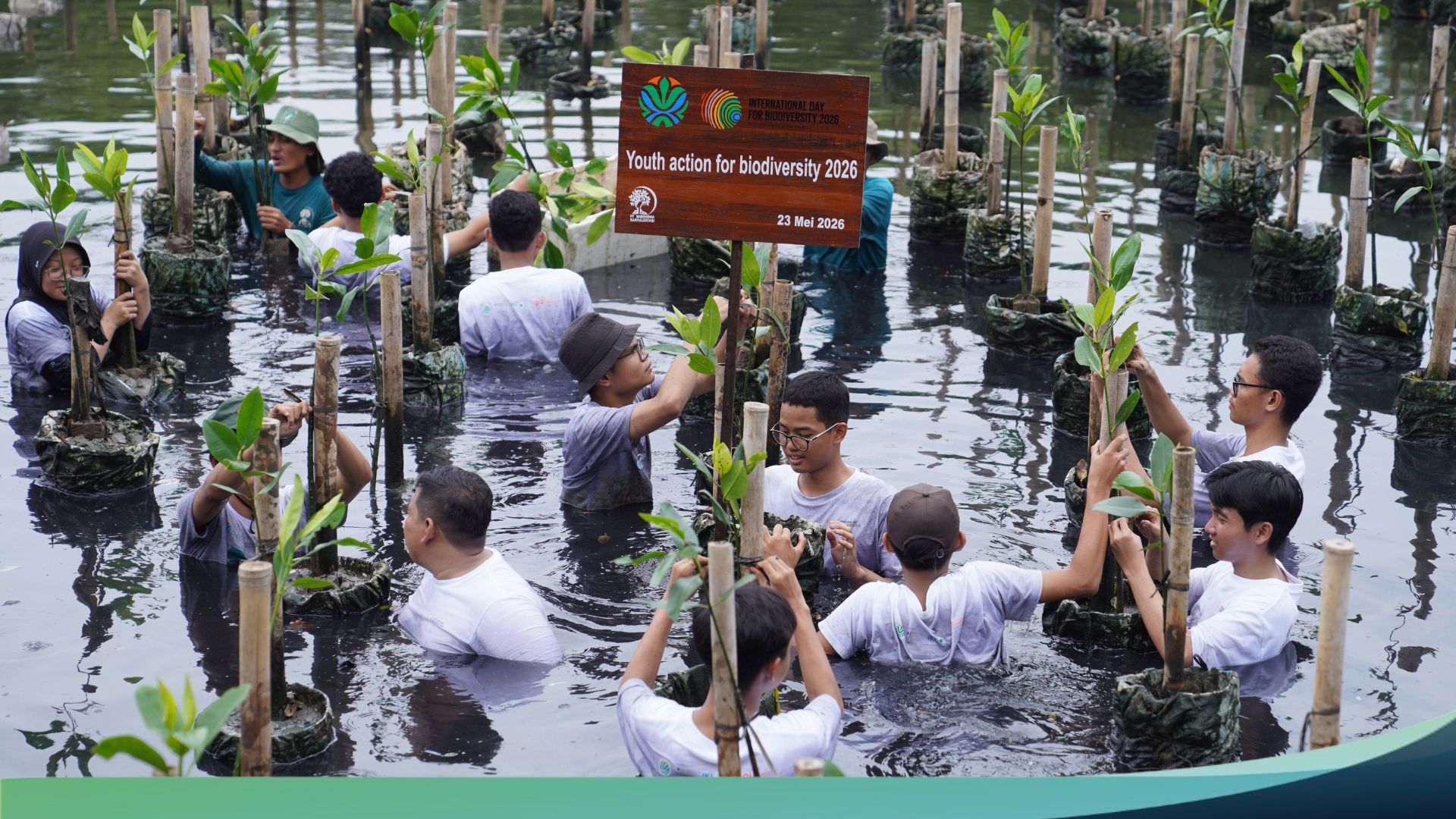
Indeed, in celebration of World Biodiversity Day 2026 (IDB 2026), the Ministry of Environment of the Republic of Indonesia, together with the International Climate Initiative (IKI-Hub Indonesia), and with support from GIZ Indonesia and ASEAN, organised a field-based educational programme on the second day of the International Day for Biological Diversity celebration. Held at the Angke Mangrove Eco-tourism Park in North Jakarta on Saturday, the initiative focused on strengthening environmental literacy among younger generations through direct engagement with coastal ecosystems.
As the event unfolded, 120 participants from 6 high schools joined a field-based educational “tour”. This initiative was designed to provide practical insights through hands-on activities, including the planting of 70 mangrove seedlings and a panel discussion on the vital role of mangrove ecosystems as a bulwark of urban ecology.
Guided by the Directorate of Biodiversity Conservation under the Deputy for Pollution and Environmental Damage Control at the Ministry of Environment, with support from the Directorate of Senior High School at the Ministry of Primary and Secondary Education, as well as the Muara Angke Mangrove Community, the programme adopted the theme “Acting Locally for Global Impact.” In the context of Jakarta’s increasingly vulnerable coastal landscape, the initiative underscored the idea that biodiversity governance is often shaped not only through international agreements and state policy, but through smaller, place-based forms of youth participation capable of linking local ecological awareness to planetary concerns.
The Angke Mangrove Eco-tourism Park was selected as the location for the programme because it represents one of the capital’s remaining urban mangrove ecosystems, and alsobecause its existence itself reflects a long history of restoration shaped by overlapping initiatives and sustained multilevel cooperation since the mid-1990s. In a city more commonly associated with coastal degradation and unchecked expansion, this landscape has gradually emerged as an example of how ecological rehabilitation, conservation policy, shared commitment, and nature-based tourism approach can be developed alongside one another rather than in tension. Its transformation underscores the extent to which urban environmental recovery is often less the product of a single intervention than of prolonged coordination between state institutions, local communities, civil society groups, and private actors.
Biodiversity Fact: Indonesia is home to around 23% of the world’s mangrove ecosystems—hosting an estimated 3.4 to 3.5 million hectares of mangrove forests, and a single hectare of mangrove forest can store up to five times more carbon than tropical rainforests on land, which is why mangroves are often referred to as “blue carbon ecosystems.” Jakarta itself also developed alongside wetlands and coastal landscapes, a connection still visible in the city’s geography today. Several districts continue to carry the prefix “Rawa”, including Rawa Badak, Rawamangun, Rawa Belong, and Rawa Gatel, signalling that these areas were once wetlands. More than simple place names, they reveal how urban settlements and forms of civilization in Indonesia historically emerged in close relationship with water ecosystems.
The initiative to involve young people in the commemoration of IDB 2026 was also intended to align with one of the seven strategic priorities outlined in the Indonesian Biodiversity Strategy and Action Plan (IBSAP) 2025–2045: positioning younger generations as future drivers of conservation through strengthened ecological literacy and a deeper sense of responsibility toward environmental stewardship. As Environment Minister Moh. Jumhur Hidayat emphasised during the International Day for Biodiversity celebration in Depok on May 22, 2026, “the younger generation must lead the future of conservation. Indonesian youth must become the generation that understands, loves, and preserves biodiversity,” Jumhur said.
The programme closed with an open discussion between participants and environmental experts, allowing the day’s field activities to evolve into a wider conversation on conservation, urban ecology, and the challenges facing Jakarta’s coastal environment. In that setting, the conversation became less about abstract ecological knowledge than about the collective responsibilities required to imagine and sustain a more resilient urban environment.
Maulana, a student from Yadika II Senior High School, said that the programme carried particular significance for him because many people of his age had never planted a mangrove tree before—or, in some cases, had little familiarity with mangrove ecosystems at all. In a city where many young people grow up distant from the ecosystems around them, he described the experience as a rare opportunity to directly understand the coastal environments that sustain urban life.
Appreciation for the initiative was also expressed by Veronika Sihombing, a representative from the Directorate of Senior Secondary Education at the Ministry of Primary and Secondary Education, who emphasised the importance of involving students directly in ecological action as a way of cultivating an early sense of responsibility toward their surroundings. She noted that daily practices such as sorting waste, planting trees, and bringing reusable tumblers and lunch containers should be continuously encouraged so that environmentally conscious behaviour becomes part of students’ daily habits rather than merely an institutional campaign.
Through this programme, GIZ, IKI, and the Ministry of Environment and Environmental Control Agency (KLH/BPLH) sought to encourage younger generations to see the ecological crisis as a condition demanding participation, responsibility, and continuity, one that may ultimately shape whether environmental protection in Indonesia remains a matter of policy alone or evolves into a sustained public commitment.