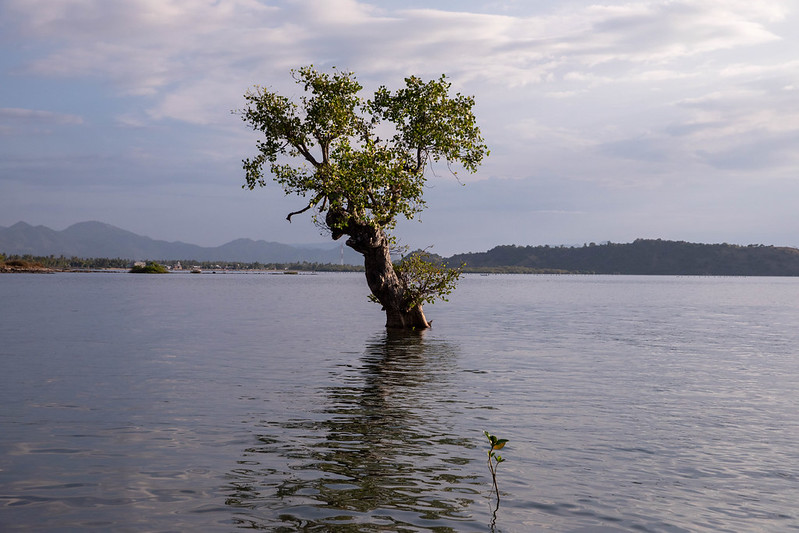
© Donny Iqbal/CIFOR-ICRAF
For Indonesians, wetlands are important. It is reflected in Indonesia’s cultural narratives such as the Legend of Rawa Pening, which signals that wetlands have long been embedded in the historical trajectories of Indonesia’s popular culture. Beyond folklore, this historical presence is also inscribed in place names. Several areas in Jakarta still carry the prefix “Rawa”, indicating that these districts were once wetlands.
Rawa Badak, Rawamangun, Rawa Belong, Rawa Gatel, etc. You name it! More importantly, these names are not merely geospatial markers because, across different historical contexts, they reveal that civilization emerged alongside wetlands.
But did you know that wetlands are disappearing three times faster than forests? This alarming phenomenon is driven by development pressures, pollution, climate change, and land conversion.
Looks familiar, isn’t it?
Wetland is a new neologism that appears at least in early 70s, before finally being recognized globally since the 1971 Ramsar Convention in Iran. At the beginning, the purpose of the convention is to encourage efforts to conserve and use wetlands wisely through national action and international cooperation to realize sustainable development around the world. To date, 172 countries have ratified this convention, and Indonesia, as a country with extensive wetland landscapes, has been a party to the convention since 1991.
Indonesia has 40.5 million hectares of wetlands, of which 1.37 million hectares are registered as Ramsar Sites in Indonesia, covering seven areas. Indonesia wetlands are vital for biodiversity, flood protection, carbon storage, and local livelihoods. Their role is not only ecological but also social and cultural, as local communities rely on wetlands for fishing, agriculture, transportation, and cultural traditions that have been passed down from generation to generation.
According to the Global Wetland Outlook, 64 percent of the world’s wetlands have disappeared since 1900. Indonesia, as a country facing widespread wetland loss driven largely by land conversion, has taken sustained measures to protect these semi-aquatic ecosystems across its regions. In 1991, after ratifying the Ramsar Convention, the Indonesian government, through Presidential Decree No. 48 of 1991, promptly established the National Committee for Wetland Ecosystem Management in 1994. Its role is to provide a platform for cross-sectoral coordination in policy formulation, to oversee the implementation of the Ramsar Convention, and to promote the protection and sustainable use of wetland ecosystems in Indonesia.
However, at a certain level, this committee failed to bring about significant change to the wetland ecosystem. Even the 1996 National Strategy Book and Action Plan for Wetland Management in Indonesia was considered insufficient to catalyse change in Indonesia’s wetland landscape. This is because the committee lacks strong executive authority, while the 1996 National Strategy and Action Plan for Wetland Management in Indonesia lacks clear implementation and monitoring mechanisms. As a result, wetland management policies have failed to bring about significant landscape change.
In addition, in 2014 a legal framework was established through Government Regulation No. 71 of 2014 on the Protection and Management of Peat Ecosystems, followed by the establishment of the Peat Restoration Agency (Badan Restorasi Gambut) through Presidential Regulation No. 1 of 2016. The impact has been significant: wetland management in Indonesia, particularly peatland, has begun to operate under a clearer legal framework and through dedicated institutions responsible for coordinating and implementing ecosystem restoration at the national level, especially in degraded and fire-prone peat areas.
Surprisingly, 4 years later, the government of Indonesia strengthened its commitment to wetland protection and restoration through Presidential Regulation No. 120/2020, which established the Peatland and Mangrove Restoration Agency (Badan Restorasi Gambut dan Mangrove). As a result, the restoration mandate was expanded beyond peatlands to include mangroves, setting a more integrated national restoration agenda. In practice, this agency was tasked with restoring millions of hectares of degraded peatlands and hundreds of thousands of hectares of damaged mangroves, while also enhancing cross-ministerial and subnational coordination in wetland governance.
It seems fair to say that the direction of wetland policy in Indonesia highlights the government’s important role in developing integrated models for planning, protection, utilization, and institutional empowerment. So, it is not an exaggeration to say that this is what keeps us dreaming of a better future for Indonesia’s wetlands.