April 2026
© IKI-Hub Indonesia Communications Team
This series sets out from the Bird’s Head Peninsula in Sorong, on Indonesia’s western edge, guided by a theme that resonates far beyond its point of origin: Acting Locally for Global Impact.
With its extraordinary levels of endemism and a mosaic of ecosystems—ranging from tropical rainforests to coastal and marine zones, mangroves, and mountainous terrains—Sorong stands as host for the Papua ecoregion in this series. Its selection is not merely a reflection of what it holds, but of what it confronts: a landscape poised at a crucial juncture in a deepening crisis of ecological resilience.
At the same time, there remains a vital opening for younger generations to engage this moment. Young people are however not simply inheritors of environmental governance; they are already shaping its contours in the present. Their contributions to the evolving debates on biodiversity will not only matter—they will determine whether they claim a place at the table where its future is decided.
In response, the Ministry of Environment of the Republic of Indonesia, together with the International Climate Initiative (IKI-Hub Indonesia), supported by GIZ Indonesia and ASEAN, has sought to recognize and amplify the dedication of young people in biodiversity management and conservation.
Conceived as an open space for learning, this initiative brings together biodiversity education, field-based experience, and creative campaigns, weaving youth engagement with the knowledge and participation of local communities.
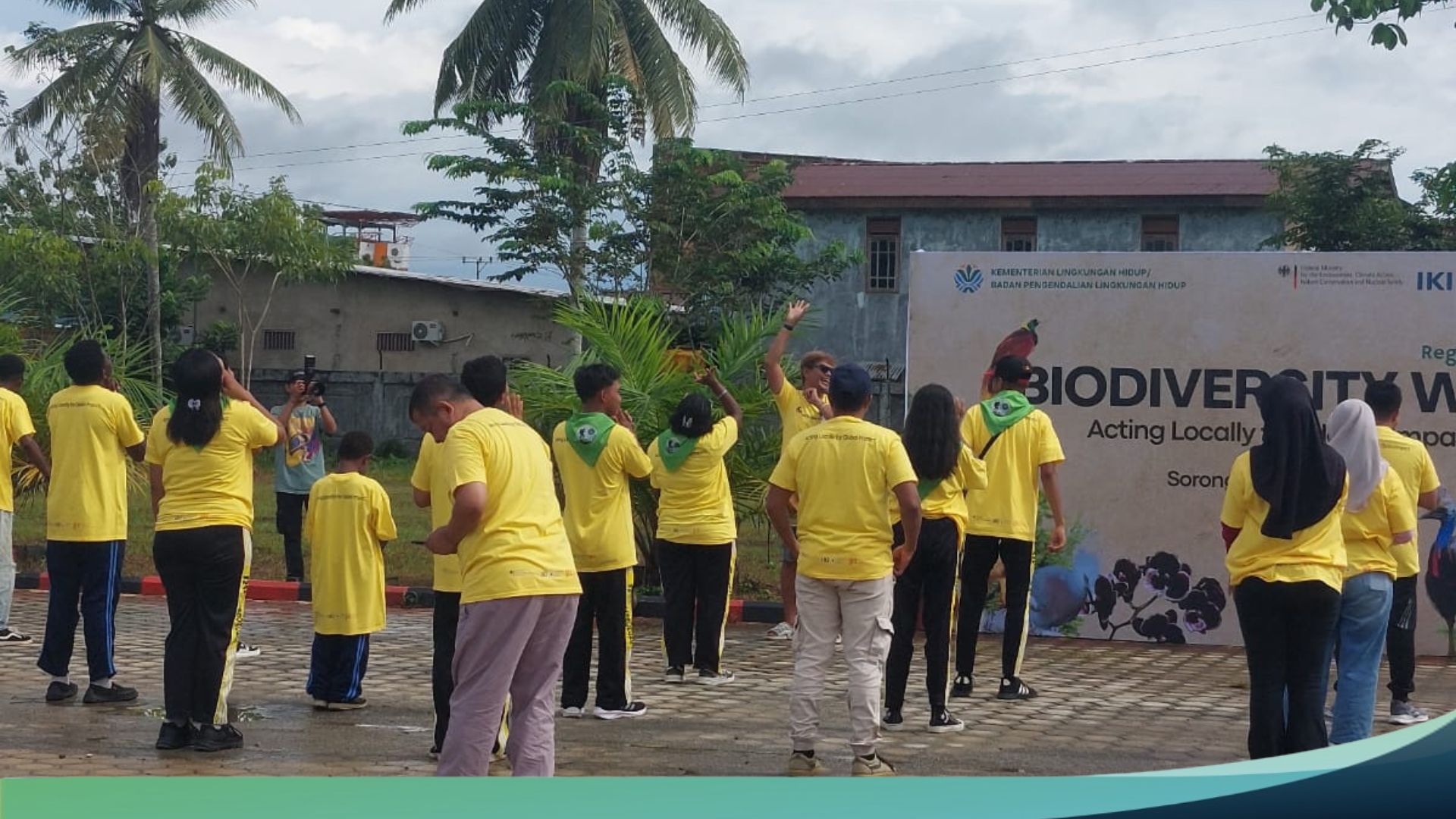
As the event unfolded, 125 participants from both high schools and universities joined a field-based educational “fun walk” through a conservation area. The initiative introduced Papua as a living repository of biodiversity, a home to an extraordinary share of the 70% world’s bird species, thousands of varieties of fish, and vast stretches of rainforest whose ecological mysteries remain only partially understood.
Within this setting, participants were invited to move from recognition to comprehension—beginning with the identification of endemic species and extending toward an understanding of the interwoven dynamics that bind forest, sea, and mangrove into a single, living system.
Guided by the Head of the Regional Office of the Natural Resources Conservation Agency (BKSDA) Papua Barat, alongside expert facilitators and scholars from the Biology Education Study Program at the Universitas Pendidikan Muhammadiyah Sorong (UNIMUD), this activity invites participants to read the landscape as a co-living system that give voluntarily the direct and non-direct benefit, shaped as much by ecological processes as by forms of human generosity for biodiversity.
Ratna Prabawati, Head of the Biology Education Study Program at the Universitas Pendidikan Muhammadiyah Sorong (UNIMUD), addressed the students with a clarity that resisted flourish. Nature, she suggested, does not announce its own distress. “Be a voice,” she urged, “for the animals, the plants, and the ecosystems. Your advocacy matters.”
Furthermore, a representative from the Balai Besar KSDA Papua Barat Daya pointed to a stark imbalance on the ground: personnel oversee only around 12,000 hectares within a conservation landscape spanning 1.7 million hectares across the Bird’s Head Peninsula of Papua, with approximately 97.6 percent of that territory remaining a monitoring “blank spot.” In such conditions, younger generations expected to emerge as potential agents of change, learning alongside local communities and working with them toward a more grounded and sustainable future for biodiversity management in Papua.
Participants were also introduced into an understanding in which the earth, human life, and the systems that sustain them are not discrete domains but intimately bound—articulated through narrative forms such as fables and parables and carried forward in customary laws and cultural values. Together, these traditions extend the moral and imaginative reach of the young generation’s reason, enduring work of environmental stewardship.
The program concluded with a dialogue and QnA session between participants, regional government representatives, and scholars, creating a space for exchange, reflection, and the articulation of shared concerns and commitments. The event ultimately closed with a symbolic gesture: the signing of a 3-meter fabric, accompanied by a declaration positioning Papua within the broader cause of global biodiversity.