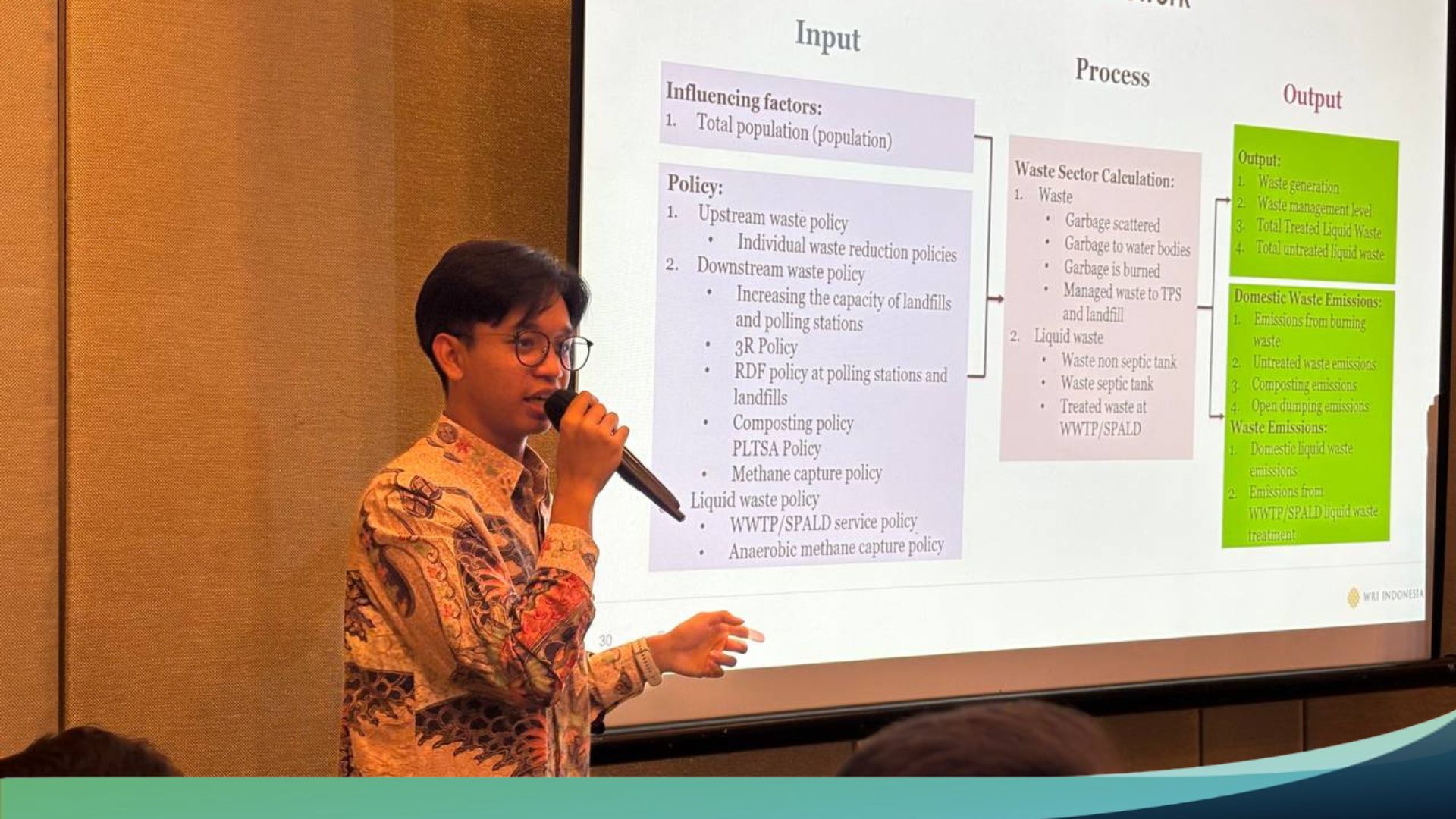
WRI Indonesia guided participants in the training session. © WRI
Good policy rarely begins with certainty. More often than not, it starts with questions about trade-offs, unintended consequences, and the subtle complexity behind every decision. In this context, science and data are not just tools, but anchors that provide a way to make choices with clarity and accountability. A systemic approach, one that recognizes connections rather than fragments, enables policies to be shaped by evidence, including insights drawn from modeling, rather than by instinct alone.
WRI Indonesia organized a capacity-building session for 29 government partners from various directorates within the PSDALP Deputyship at the Ministry of National Development Planning/Bappenas. The session brought together planners, analysts, and decision-makers, all of whom were grappling with the challenge of translating complexity into actionable policy.
Anna Amalia from Bappenas set the tone with an encouraging message about the importance of communicating with data. Over the next few hours, Egi Suarga and Fahri Santosa from WRI Indonesia guided participants through modeling simulations, showing them how policies might play out over time and demonstrating that these simulations are not just abstract exercises.
By the end of the session, a shared language had emerged that connected data, systems thinking, and decision-making. This training forms part of a longer journey. In the months ahead, WRI Indonesia will continue to work alongside the PSDALP Deputy at Bappenas to strengthen the foundations for climate modeling to inform more grounded, evidence-based policies.