© IKI – Communication
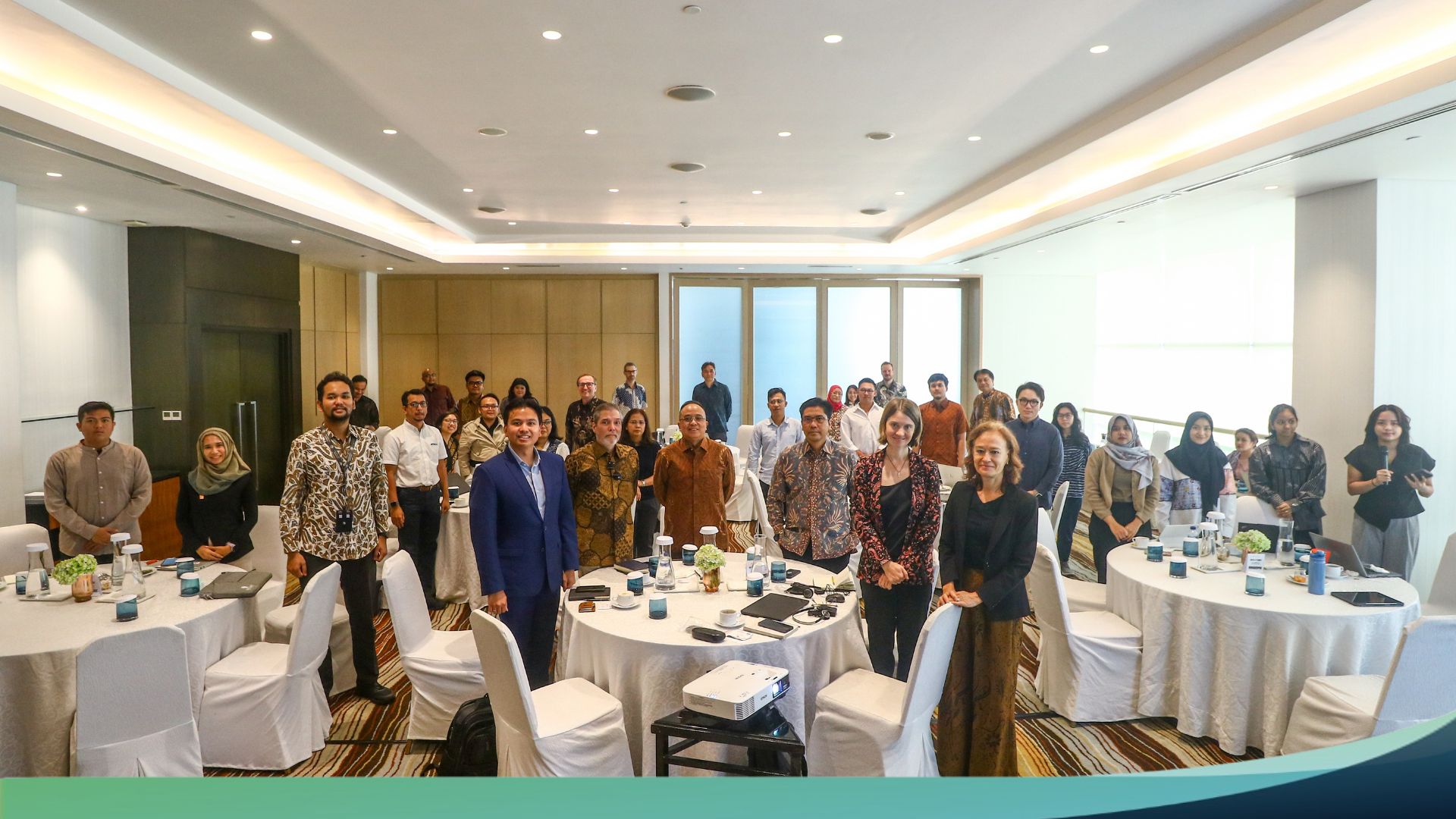
As part of the effort to gain an understanding of the objectives behind the issuance of Presidential Regulation 110/2025, a discussion organized by IKI Hub Indonesia. The workshop brought together key stakeholders including the Special Envoy of the President for International Trade and Multilateral Cooperation, private-sector carbon actors, research institutions, and development partners to share knowledge and insights on the regulation. This discussion also functioned as a forum to enrich the discourse of Indonesia’s carbon economy while weighing the potential implications of the regulation on Indonesia’s carbon market framework and pinpointing key challenges and opportunities for its effectiveness.
After 25 years of stagnation, the Indonesian government is now targeting an economic growth rate of 8 percent for 2025–2029. One of the new sources of financing to achieve this ambition is the maximization of carbon pricing scheme. To support this objective, the government significantly shaking up the old-school model of carbon pricing development, as introduced under Presidential Regulation 110/2025. This regulation revokes and replaces Presidential Regulation 98/2021, which was seen to contain unresolved tensions between economic activities and carbon planning, a tension that, for several reasons, could impede market flow. This regulation also aims to simplify the carbon trading mechanism while maintaining strsong carbon governance.
The “hot take” on Indonesia’s carbon market
Ardi Wardhana, Special Envoy of the President for International Trade and Multilateral Cooperation, noted that this new regulation offers at least three key opportunities for the development of Indonesia’s carbon ecosystem: the separation of NDCs and the carbon market, decentralization through government mandates—including an interoperability system, and critical adjustments to carbon credit procedure.
“Presidential Regulation 110/2025 is expected to streamline Indonesia’s carbon-economic processes, creating a more visible and expansive market. Through this very specific regulatory ecosystem, the regulation is also anticipated to generate additional demand from international markets.”
Yet, the question of who is more capable of managing the carbon market and whether our commitment to the NDCs remains strong enough through this regulation has sparked an interesting discussion. Both, Chairman of Indonesia carbon trade association and the IDX Carbon representative agree that a key missing element in this regulation is the simplification of carbon transaction execution—specifically, the development of a carbon transaction system comparable to the IDX stock exchange platform. Riko Wahyudi, a researcher at the Research Center for Climate Change of Indonesia (RCCC-UI), also stated the separation between the NDCs and the carbon market (article 58) is a hasty decision, as it requires more thorough evaluation because Indonesia’s NDC calculations and achievement tracking remain insufficiently comprehensive.
“This regulation should not encourage carbon trading on the one hand, while risking Indonesia’s failure to achieve its NDC targets by 2030, on the other hand.”
Eye-opening insight
Priority Scale—with this regulation, the Indonesian government will no longer need to debate the priority scale between carbon taxes, cap-and-trade schemes, compliance carbon markets (CCM), or voluntary carbon markets (VCM). Instead, it will move forward in an integrated manner, bringing all these instruments together to create a more connected carbon ecosystem.
Action Plan—in the next two years, the government will step up efforts to issue ministerial regulations derived from Presidential Regulation 110/2025, establish the Carbon Unit Registry System (SRUK) as a centralized registry connected to all carbon systems, prioritize ETS pilots in the industrial sector specifically for commodities impacted by mechanisms like CBAM, and reinforce the role of the Steering Committee to oversee decentralized governance and coordinate closely with the Financial Services Authority (OJK) as the supervisory pillar for the carbon exchange.
Alternative Model—this regulation is expected to pave the way for discourse on alternative models for the Technical Approval for Emission Limits (PTBAE) such as carbon allowance auction systems or allocation mechanisms within an emissions trading scheme (ETS), as a means of tackling market failures through carbon pricing.
Progressive and fair approach calling
At the end of the discussion, there was a call for a progressive and fair carbon trading ecosystem that not simply captures the economic value of carbon but also mitigates environmental and economic risks through regulations derived from this presidential regulation. Beyond the various inputs, criticisms, and suggestions regarding the Presidential Regulation 110/2025, the main challenge lies in ensuring that this policy manifested throught concrete and consistent implementation that supports both the national climate targets and the government’s ambition of achieving 8% economic growth