October 2025
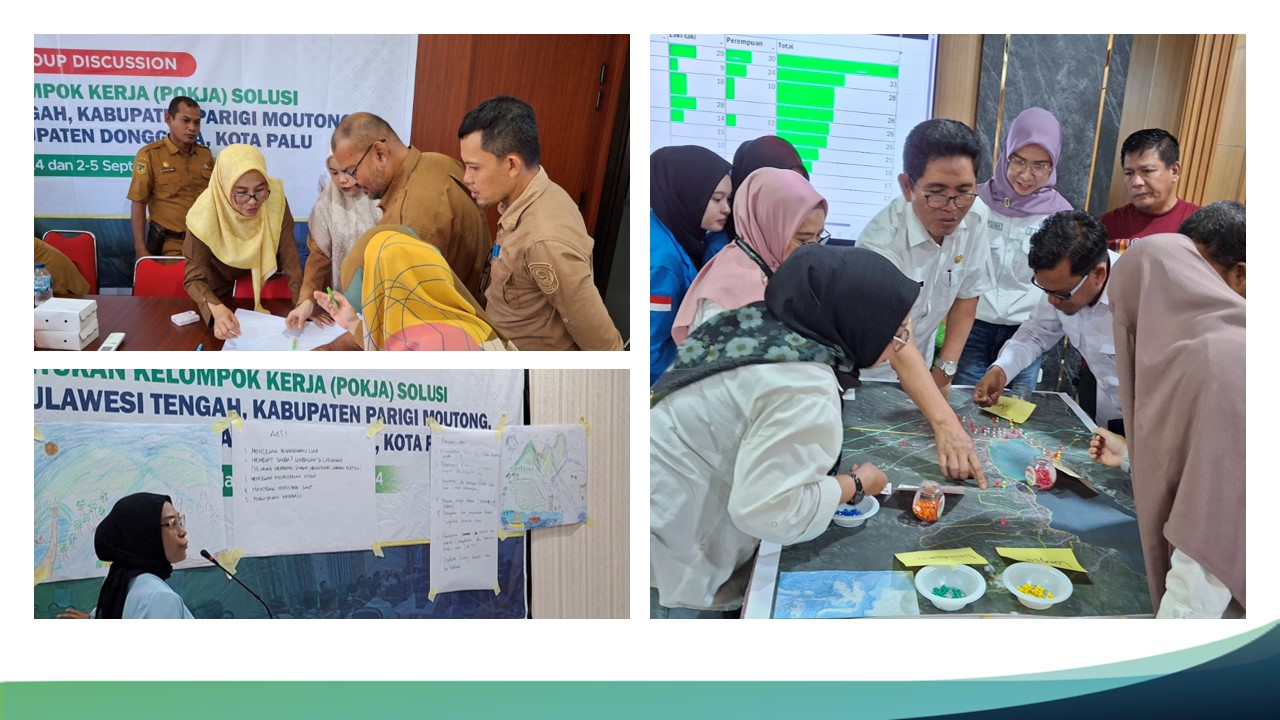
© SOLUSI / The FGD process in Central Sulawesi
“The establishment of the Working Group (Pokja) is highly appropriate, as land–seascape issues require multi-stakeholder collaboration.” Said Muhammad Farid Isra Aprilyansyah from the Public Works and Spatial Planning Agency.
The establishment of a Working Group (Pokja) in Central Sulawesi has brought renewed energy to the integrated management of land and seascapes. Isra also emphasized that, with its multisectoral nature, the Working Group (Pokja) can support program implementation while at the same time fostering collaboration.”
Through the SOLUSI project, Pokja members participated in a series of FGDs that not only provided technical skills but also fostered new perspectives. They learned how to prepare data, design master plans, and integrate land and seascape planning for greater coherence.
However, the journey has not been without challenges. Farid admitted that sectoral interest and lack of one data management often posed obstacles. “We need a better data-sharing mechanism and consistent participation from Pokja members to ensure smooth progress,” he remarked.
Wahyuni P. from Palu’s Bappeda noted the tangible benefits of the FGDs. “Previously, we were still unsure about the direction of land–seascape management. Now, the issues are more focused, and the roles of each institution are clearer,” she said.
Meanwhile, Ederian from the Marine and Fisheries Agency emphasized the importance of integrating spatial planning with ecosystems. He expressed hope that stronger land–sea spatial data could serve as a foundation to ensure that upstream activities do not cause downstream damage.
The stories of Pokja members illustrate that collaboration is not just rhetoric, but a concrete key to achieving sustainable management.