August 2025
Gandabhaskara Saputra – Communications Focal Point, Resilient Nature Cooperation Area
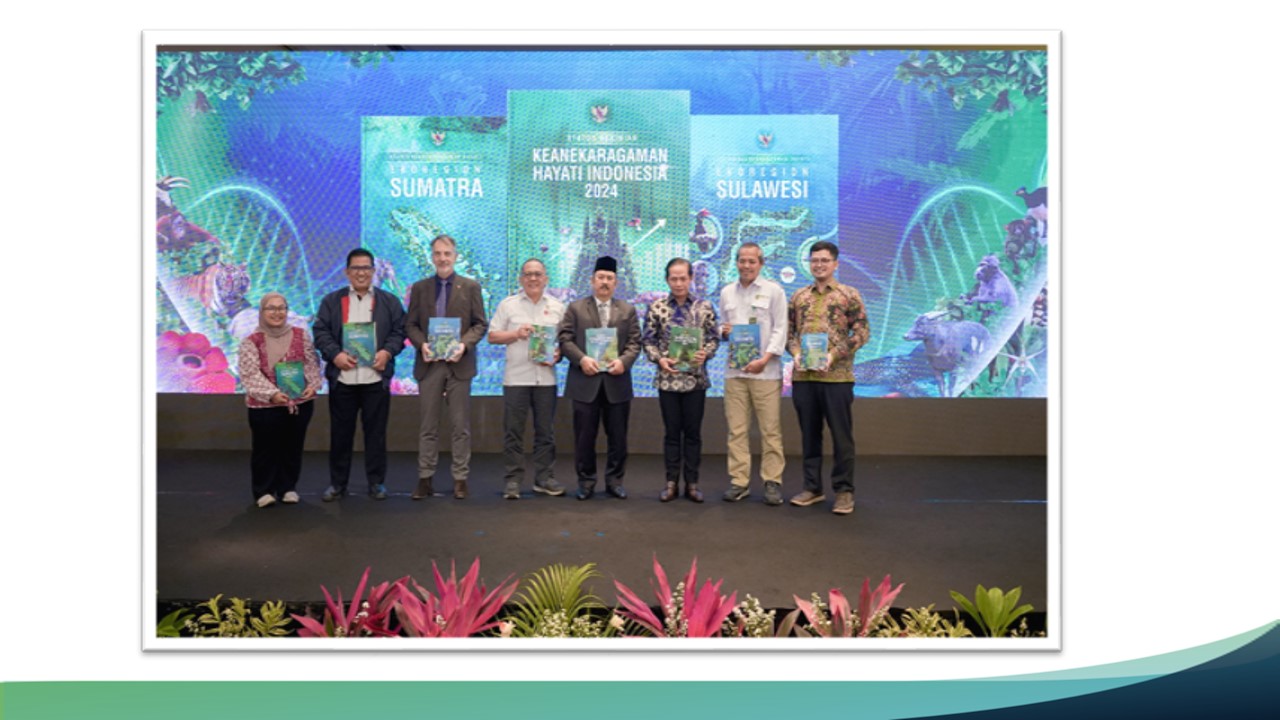
© The Book Launch of the Current Status of Indonesia’s Biodiversity 2024, 19th of August 2025
Indonesia and Germany reaffirmed their partnership in advancing biodiversity conservation at the official launch of the Current Status of Indonesia’s Biodiversity 2024 along with detailed updates for the Sumatra and Sulawesi ecoregions. The event, held in Jakarta, marks a milestone in the country’s effort to strengthen evidence-based strategies for biodiversity management while aligning with global commitments under the Kunming–Montreal Global Biodiversity Framework.
Representatives from the Government of Indonesia and GIZ Indonesia-ASEAN attended the ceremony alongside key ministries, research institutions, and other Non-state Actors including Working Group ICCAs Indonesia (WGII). The documents launched today are part of broader efforts to provide the most recent scientific knowledge and policy-relevant insights on Indonesia’s biodiversity richness, challenges, and priorities for action.
Speaking at the event, Hans-Ludwig Bruns, Country Director of GIZ Indonesia, emphasized the pivotal role that knowledge plays as the starting point for sustainable biodiversity management:
“Effective biodiversity management begins with knowledge. We must first understand what we have—our biodiversity resources and their current status. Only with a solid foundation of knowledge can we plan and implement conservation and management measures effectively.”
He also highlighted the long-standing partnership between Germany and Indonesia in this area. GIZ, on behalf of BMUKN, has been supporting Indonesia in areas ranging from data collection and strategic planning to monitoring and mobilizing financing mechanisms essential for implementing biodiversity actions. This includes GIZ’s support in the formulation of the Indonesia Biodiversity Strategy and Action Plan (IBSAP) 2025–2045, Indonesia’s long-term framework for biodiversity management.
“The IBSAP will serve as an operational guide at the national and subnational level, aligning Indonesia’s priorities with the global framework while ensuring they are rooted in the country’s development ambitions,” he remarked.
Acknowledging the leadership of Indonesia’s government, he extended appreciation to the Ministry of National Development Planning (Bappenas), the Ministry of Environment (KLH) the National Research and Innovation Agency (BRIN). Their stewardship has ensured that biodiversity is recognized as a key pillar in Indonesia’s long-term vision for prosperity, resilience, and climate action.
Yet, he underlined that knowledge and documents alone are not enough. Collaborative leadership is vital.
“The task ahead requires working across ministries, across scientific disciplines, and across sectors. Only through strong partnerships can Indonesia safeguard its natural wealth while advancing its development aspirations,” he stated.
Looking forward, GIZ reiterated its commitment to act as a strategic development partner for Indonesia, facilitating dialogue, mobilizing expertise, and fostering international cooperation. Beyond biodiversity, GIZ is also working hand in hand with Indonesia on energy transition, circular economy, climate change resilience, sustainable forestry, and urban development—areas that are interconnected with nature conservation and national development.
The launch of the biodiversity status documents for Indonesia, Sumatra, and Sulawesi is expected to serve as a scientific foundation and policy reference to guide evidence-based interventions, strengthen coordination, and enhance collective action for the protection of Indonesia’s unique biodiversity.