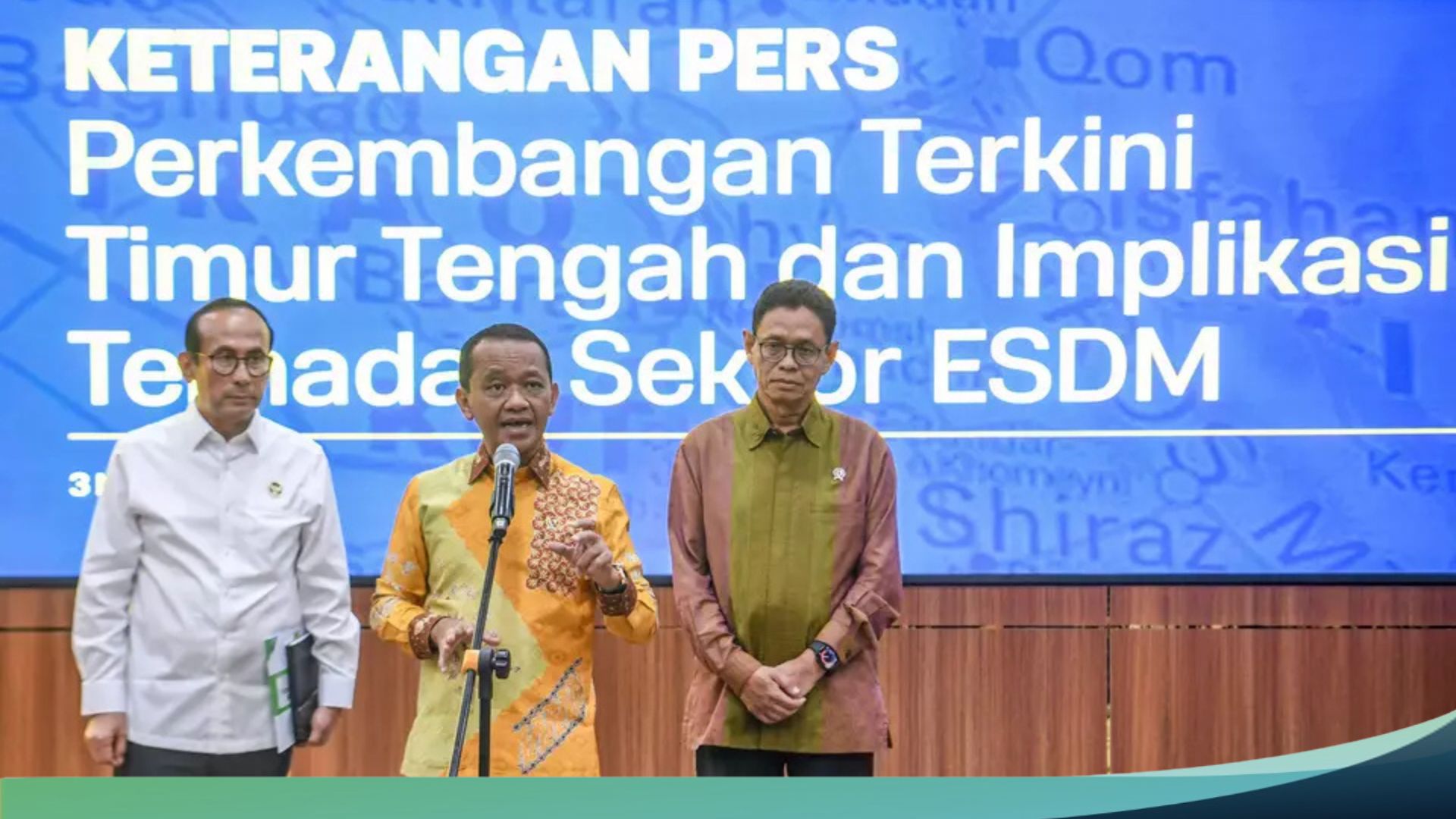
Energy and Mineral Resources (ESDM) Minister Bahlil Lahadalia (center) accompanied by Deputy Minister Yuliot Tanjung (right) and Member of the National Energy Council (DEN) Satya Widya Yudha (left) gave a press statement regarding the Latest Developments in the Middle East and Implications for the Energy and Mineral Resources Sector at the ESDM office, Jakarta © Antara Photo/Muhammad Adimaja/wsj
In late March 2026, the Indonesian government formally framed the ongoing Middle East crisis and elevated oil prices as a strategic accelerator for the energy transition. Investment and Downstreaming Minister Rosan Roeslani announced at a virtual press conference that the government is determined to scale up new and renewable energy investment to shield the economy from increasingly complex global dynamics, with a specific focus on geothermal, solar and hydropower. Coordinating Minister for Economic Affairs Airlangga Hartarto reaffirmed the strength of Indonesia’s economic fundamentals against the backdrop of the global volatility.
The package brings together an uneasy pairing of supply-side ambition and demand-side restraint. On the supply front, President Prabowo has tasked Energy and Mineral Resources Minister Bahlil Lahadalia with leading a National Energy Transition Acceleration Task Force, whose remit includes an expansive 100-gigawatt solar programme—particularly oriented toward schools and village-level installations—set against an estimated national solar potential of more than 3,200 gigawatts. At the same time, the government is pressing ahead with the rollout of the B50 biodiesel mandate, requiring a fifty-per-cent palm-oil blend beginning 1 July 2026, a policy framed as both a transitional instrument and a means of easing the fiscal burden of fuel subsidies.
On the demand side, the measures are more immediate, if less structural: mandatory work-from-home arrangements for state employees on Fridays and a reduction in the use of official vehicles have already been introduced, with similar guidance for the private sector remaining non-binding. Speaking at a press conference in Jakarta on 3 March 2026, Bahlil indicated that the government is also studying more far-reaching adjustments, including a shift toward remote work or even a four-day workweek, explicitly drawing on recent measures in the Philippines under President Ferdinand Marcos Jr., where compressed schedules and reduced physical activity mandates have been linked to targeted cuts in electricity and fuel consumption. In Indonesia, such proposals remain exploratory, but they reflect a growing recognition within policy circles that managing demand—no less than expanding supply—will be critical to any meaningful reduction in fossil-fuel dependence.
On energy security, Bahlil confirmed at the same press conference that national fuel reserves currently cover approximately 23 days of demand. He stressed that this figure does not signal a supply crisis linked to the Middle East situation but reflects the structurally limited domestic energy storage capacity. The government plans to build new strategic storage facilities capable of holding up to three months of fuel reserves. ESDM separately confirmed that imports from the Middle East currently account for around 20 % of Indonesia’s fuel demand, and that alternative supply sources have been secured — including a shift in LPG and crude oil sourcing toward the United States under the framework of a USD 15 billion bilateral trade arrangement.
Sources: Antara News – Indonesia to boost renewable energy investment to shield economy (1 April 2026); Antara News – Indonesia diversifies energy sources (1 April 2026); Antara News – Renewable energy: Indonesia’s strategy to face global crisis (24 March 2026); Jakarta Globe – Following Philippines, Indonesia Eyes 4-Day Workweek to Cut Fuel Use (3 March 2026)