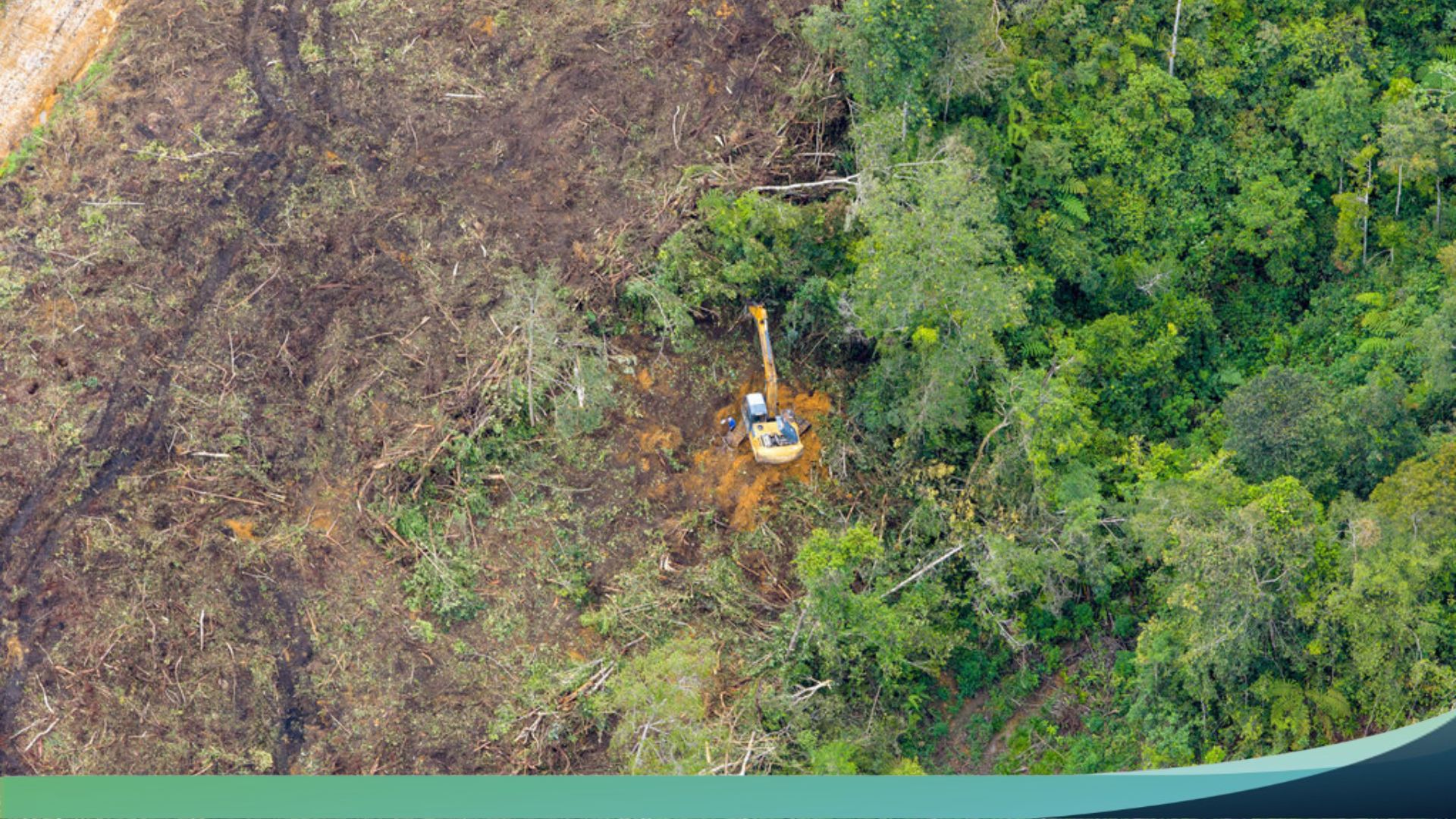
Deforestation resulting from expansion in the PT Toba Pulp Lestari pulpwood concession’s Aek Raja sector, North Tapanuli, North Sumatra © Auriga Nusantara, Desember 2025.
On 31 March 2026, the NGO Auriga Nusantara published its annual report “Indonesia Deforestation Status 2025” (STADI 2025). The report finds that Indonesia lost 433,751 hectares of forest in 2025 — a 66 % increase from the 261,575 hectares recorded in 2024 and the highest annual deforestation level in eight years. The methodology combines Sentinel-2 deep-learning detection with extensive ground verification (field visits across 49,321 hectares in 28 regencies and 16 provinces), and the dataset is reported with an overall accuracy of 89 %. Approximately 71 % (307,861 ha) of forest loss occurred inside the Forest Estate under the Ministry of Forestry, while the remaining 125,890 hectares occurred in Other Land Use (APL) areas managed by regional governments and concession holders.
Kalimantan remained by far the largest contributor in absolute terms (158,283 ha), with Central Kalimantan ranked as the single most-deforested province in 2025 (56,900 ha). The largest absolute expansion compared with 2024 occurred in Papua (+60,337 ha / +348 %), confirming a pronounced eastward shift of the deforestation frontier. The highest percentage increases at the regional level were recorded in Java (+440 %), although in absolute terms Java remains marginal. The three northern Sumatra provinces affected by the late-2025 flood disasters show extraordinary year-on-year surges in deforestation: Aceh (+426 %), North Sumatra (+281 %) and West Sumatra (+1,034 %) — a pattern Auriga and civil society groups link directly to the disaster narrative. The top ten regencies are concentrated in Kalimantan (Berau, Kutai Timur, Kapuas, Kapuas Hulu, Katingan, Murung Raya, Gunung Mas, Bulungan) and Papua (Sorong, Merauke), and together account for around 22 % of national deforestation.
Several drivers stand out. Roughly 79,408 hectares—about eighteen per cent of Indonesia’s total deforestation in 2025—occurred within the 20.6 million hectares designated for the government’s food, energy, and water reserves programme, a figure that acquires greater urgency in light of Auriga’s estimate that some 8.8 million hectares of these areas remain primary or otherwise intact natural forest. A further 25,077 hectares were lost inside formally protected conservation zones, including Kerinci Seblat National Park (6,362 hectares), Mount Leuser National Park (1,379 hectares), and Lorentz National Park (889 hectares), suggesting that legal status alone no longer guarantees ecological security. Most strikingly, Auriga documents 156,463 hectares of deforestation across the habitats of Indonesia’s iconic megafauna — Sumatran tigers, rhinos, elephants and orang-utans — with the Sumatran tiger habitat alone losing 78,049 hectares. Auriga attributes the overall trend reversal to weakened safeguards under the Job Creation Law and the systematic acceleration of National Strategic Projects (PSN), most prominently the Merauke Food Estate.
Sources: Auriga Nusantara – STADI 2025 presentation (31 March 2026); Mongabay, 4 April 2026; The Online Citizen, 1 April 2026