Road to Ocean Impact Summit (OIS) 2026 at Glance
The road to the Ocean Impact Summit is a long one, by design. Between May 16 and June 9, the Road to the Ocean Impact Summit 2026, held within the broader commemoration of World Ocean Day and Coral Triangle Day, unfolds across ten locations, from coastal villages to major cities, through mangrove planting, beach clean-ups, and marine festivals in Bali, each one a different entry point into the same conversation about what Indonesia’s ocean is, and what it could still become. All of it, gathered under the theme ‘Know Your Ocean, Take Your Action,’ builds toward a single day in Bali, where the main stage event is a moment intended to be less an announcement than a culmination of weeks of collective action, awareness, and shared commitment.
Where It All Comes Together?
That series culminates on June 7, at Peninsula Island in Bali, where marine stakeholders, policymakers, conservationists, and communities gather for an exhibition that brings the marine’s story out of policy documents and into the public space, making visible what is too often left complex: the species, the ecosystems, and the human lives indeed staked on what happens next.
Why This Matters for Indonesia’s Marine Sector?
Over the past few years, marine and ocean biodiversity has emerged as one of Indonesia’s most strategic assets, possessing immense ecological, social, cultural, and economic value, while also serving as a backbone for food security, and public welfare. Yet the significance of these ecosystems does not end at the country’s coastal and territorial waters. Beyond national jurisdictions, in the vast expanse of the high seas, ecological processes remain deeply interconnected with the health and resilience of Indonesia’s marine resources, underscoring the need for stewardship that extends beyond borders. However, beneath this growing recognition, high pressure on biodiversity continues to emerge due to land-use, habitat degradation, overexploitation, and the lack of legal clarity regarding marine resource management.
Amid these layered and often intractable challenges, Indonesia has chosen to cast its lot with a new global compact, officially ratifying the treaty better known as the BBNJ Agreement, negotiated under the long shadow of UNCLOS and the United Nations. Hard-won in the way that most things worth having tend to be, the agreement is expected to enter into force in January 2026, marking what many hope will be the beginning of a new era in how the world governs the vast, largely ungoverned stretches of ocean that belong, in theory, to everyone, and in practice, to no one.
Ratified at the UN Ocean Conference 2025 in Nice, France, through Presidential Regulation No. 67/2025, the BBNJ Agreement made Indonesia the fifty-first country to sign on, a number that sounds modest until you consider what it represents. It is, by most accounts, a strategic bet, one rooted in the recognition that Indonesia sits atop some of the most biologically extravagant and vital waters on earth. The ratification is expected to curb overexploitation, anchor sustainable resource governance, and nurse damaged marine ecosystems back toward health. Yet there is also the matter of obligation. As the world’s largest archipelagic state, Indonesia occupies a distinctive position in the global ocean landscape, one that lends very particular “weight” to its contribution toward the conservation and sustainable management of marine life in areas beyond national jurisdiction. Through this vision, ratification is thus a signal of Indonesia’s willingness to help shape the stewardship of the shared ocean commons.
That ratification also inevitably signals a growing urgency to move from agreement to actions. A treaty, however, carefully codified, does not govern an ocean on its own. The real work lies in translating its provisions into practical area-based management praxis, building institutional capacity, and developing governance mechanisms robust enough to hold. This is partly, where Living High Seas (LHS): Pioneering High Seas Marine Protected Area Action, a global initiative funded by Germany’s International Climate Initiative (IKI), implemented by Deutsche Gesellschaft für Internationale Zusammenarbeit (GIZ), comes in.
Ilka Wagner, Head of Division for Marine Biodiversity, Marine Protected Areas, and Marine Climate Protection at BMUKN, emphasized that the entry into force of the BBNJ Agreement marks the beginning of a crucial implementation phase, where global efforts must focus on translating commitments into tangible action for the conservation and sustainable use of marine biodiversity. Through the Living High Seas initiative, Germany and its partners seek to establish the foundations for the first generation of Area-Based Management Tools (ABMTs), including Marine Protected Areas (MPAs), by fostering partnerships across countries, sectors, and international institutions. Ultimately, the initiative aims to strengthen collaborative approaches to protecting marine biodiversity for the benefit of both people and nature.
For Indonesia, the project offers a way to connect its existing policy frameworks to the high seas, while supporting the country’s target of conserving thirty percent of its marine area by 2045, a commitment that places it squarely within the global 30×30 ambition under the Convention on Biological Diversity.
In addition, much of that work also flows through a single, if ungainly, concept: area-based management tools, or ABMTs, and their most recognizable form, marine protected areas. These are the instruments through which the BBNJ Agreement is expected to do its most tangible work, designating stretches of the high seas for protection, regulating what can be taken and what must be left alone. The legal scaffolding, at least on Indonesia’s side, is already partly in place. Law No. 32/2014 on Marine Affairs provides the mandate for conserving and managing living resources in the high seas, while Government Regulation No. 32/2019 on Marine Spatial Planning maps the ecological connective tissue between waters within and beyond national jurisdiction.
Together, they give ABMTs something to land on. And through the NBSAP, Indonesia’s national biodiversity strategy, those tools feed into broader commitments to species conservation and ecosystem health, making the high seas, for perhaps the first time, feel genuinely continuous with the rest of what Indonesia is trying to protect.
What to Expect on June 7
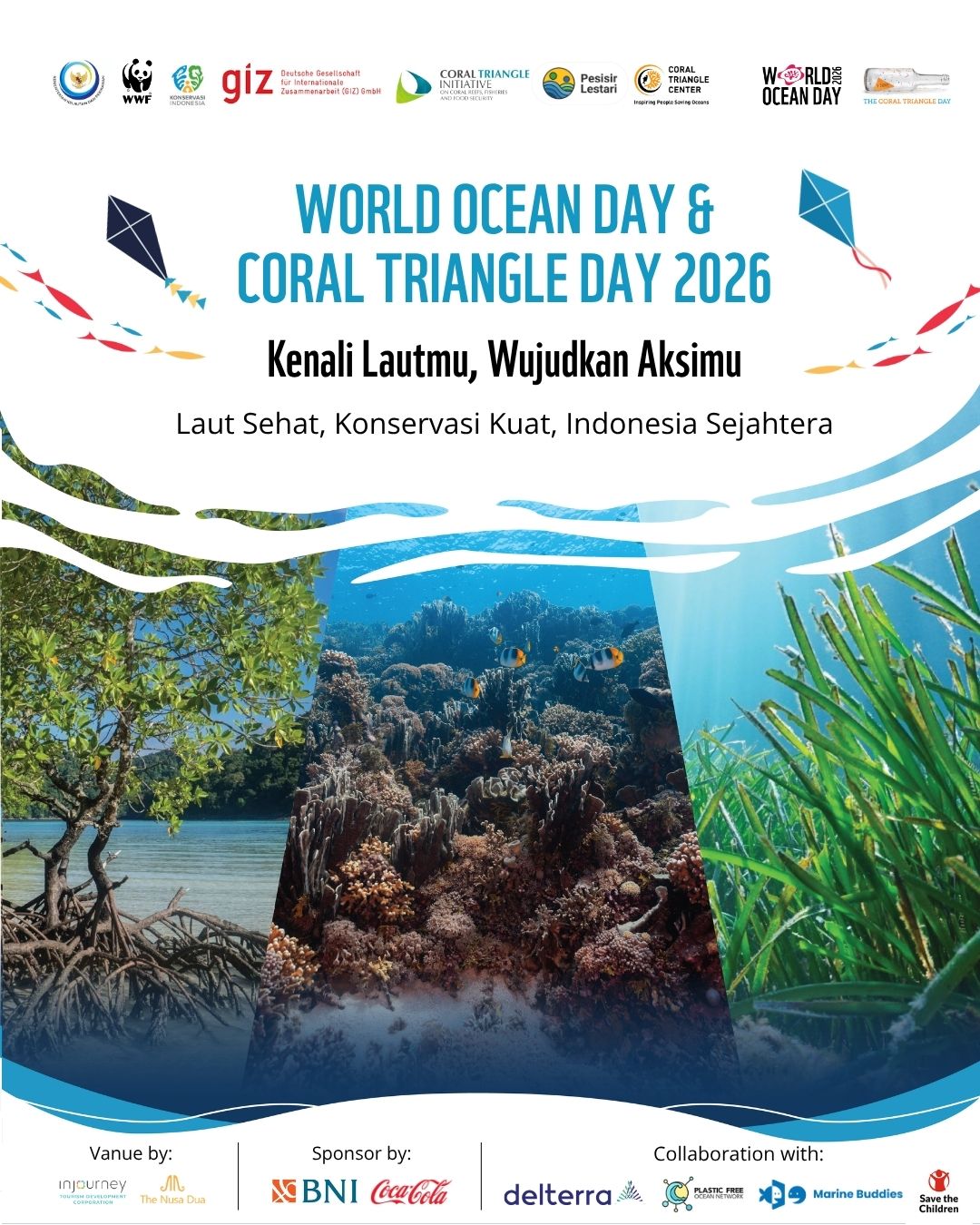
On June 7, the work unfolds closer to shore, in the form of public engagement. In collaboration with the Indonesian Ministry of Marine Affairs and Fisheries, WWF-Indonesia, and Konservasi Indonesia, the initiative of course weaves its ambitions into the fabric of World Ocean Day and Coral Triangle Day 2026, as well as the Road to the Ocean Impact Summit later that year, all gathered under the theme ‘Know Your Ocean, Take Your Action.’ The hope, stated plainly, is that these occasions stop being merely ceremonial and become, instead, a forum where knowledge travels, awareness takes root, and the distance between policy and public begins, however slowly, to close.
There’s also the matter of making it legible and compelling to others. At the main event, GIZ Indonesia & ASEAN will be on the ground with a booth designed to do what policy portfolios rarely manage. The space will showcase GIZ’s marine programs and cross-cluster conservation initiatives through knowledge products in both digital and physical formats, crafted to be as visually arresting as they are informative and entertaining. Beyond the booth, the day also features talk shows, sharing sessions, and workshops led by experts and partners from across the marine sector, offering visitors not just something to look at, but something to learn, debate, and carry home.
Stay updated and join the Road to the Ocean Impact Summit 2026 by completing the form below!