October 2025
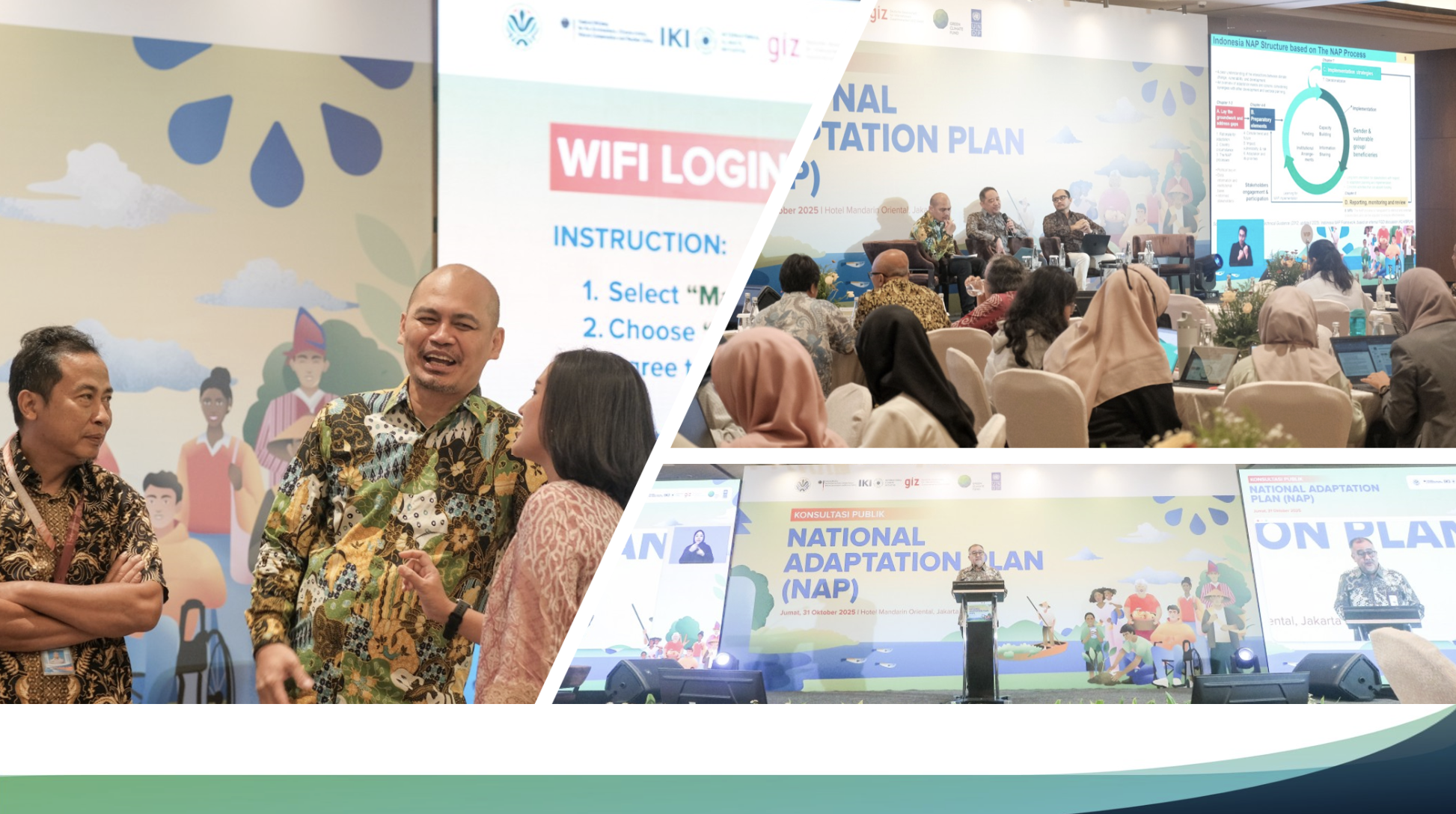
The Indonesian Government, through the Ministry of Environment (KLH), in collaboration with relevant ministries and institutions, held a public consultation on the National Adaptation Plan (NAP) on October 31, 2025, in Jakarta. The activity was supported by the German Federal Ministry for the Environment, Nature Conservation, Nuclear Safety and Consumer Protection (BMUV) under the International Climate Initiative (IKI), implemented by Deutsche Gesellschaft für Internationale Zusammenarbeit (GIZ) GmbH through the Climate and Biodiversity Hub Indonesia Project and Bioclime, as well as by the GCF Readiness Funds for the NAP Project titled “Accelerating Climate Change Adaptation Investment Planning to Enhance Resilience in Indonesia.” This consultation served as a platform for multi-stakeholder participation in shaping more integrated, inclusive, and evidence-based climate change adaptation policies.
Context and Urgency
Indonesia faces increasingly severe climate risks. In 2024 alone, more than 1,400 extreme hydrometeorological events, including extreme weather, floods, droughts, and forest fires – were recorded, causing widespread economic losses. Additional threats such as mangrove degradation, declining agricultural and fisheries productivity, and increasing heat-related illnesses further underscore the urgency of developing a comprehensive national adaptation plan.
Focus and Structure of the NAP
The NAP focuses on five priority sectors: Water, Food, Health, Ecosystem and Energy – with Disaster Management as a cross-cutting theme. The document aligns with Indonesia’s Nationally Determined Contribution (NDC), National Communication (NatCom), Biennial Transparency Report (BTR), and National Development Planning processes. Its goals are to reduce vulnerability to climate impacts by building adaptive capacity and resilience, facilitate the integration of adaptation actions (API) into policies and programs, and uphold key principles: country-driven, transparent, gender-sensitive, and non-prescriptive.
The NAP comprises four main components:
A. Laying the groundwork and addressing gaps – outlining the rationale for adaptation, country context, and NAP process;
B. Preparatory elements – assessing climate trends, risks, vulnerabilities, and identifying adaptation priorities;
C. Implementation strategies – detailing actions across key sectors; and
D. Reporting, monitoring, and review – ensuring accountability and continual improvement.
Key Institutional Inputs
Ministry of National Development Planning / National Development Planning Agency (Bappenas) emphasized that integrating the NAP into the national development planning system, aligned with RPJPN 2025–2045 and RPJMN 2025–2029 through the Climate Resilient Development (PBI) framework, ensures climate adaptation becomes an inherent part of national policy and implementation. Cross-sectoral collaboration among ministries and agencies is expected to reduce potential economic losses and enhance community resilience.
The Ministry of Home Affairs/ Kemendagri underscored the strategic role of the Regional Secretariat (Setda), particularly the Natural Resources Division, as the coordinator of multi-sectoral adaptation efforts at the subnational level. Integration of Regional Adaptation Action Plans (RAD-API) into regional planning documents is vital for achieving NAP targets. Strengthening Monitoring, Evaluation, Learning, and Transparency (MELT) systems will empower local governments to tailor adaptation actions to their regional contexts.
The Ministry of Finance / Kemenkeu) noted that the government has allocated the state budget to climate action since 2016. Instruments such as ecological-based fiscal transfers, green sukuk, and access to international climate finance (including the Green Climate Fund) serve as important funding mechanisms. However, private sector participation remains limited due to challenges in quantifying the returns on adaptation investments.
Emerging Themes and Next Steps
Participants also highlighted the importance of data and technology strengthening, particularly in climate modeling and real-time data provision through the Meteorology, Climatology, and Geophysics Agency (BMKG). The education and food security sectors were identified as critical areas for adaptation, emphasizing the need to update infrastructure, curricula, and production systems to enhance resilience while contributing to emission reduction.
The forum concluded with a collective call to: Integrate mitigation and adaptation efforts across regional planning documents; Develop clearer outcome indicators; and reinforce cross-sectoral and multi-stakeholder collaboration.
The National Adaptation Plan (NAP) reaffirms Indonesia’s commitment to building comprehensive climate resilience, protecting ecosystems, maintaining economic sustainability, and safeguarding public welfare amid the growing complexity of climate challenges.