June 2025
Environmental efforts often focus separately on land or marine ecosystems, yet Indonesia archipelagic landscape requires a more connected approach. Actions on land, such as deforestation, unsustainable agriculture, or industrial waste, flow into rivers and eventually impact marine ecosystems and their biodiversity. Therefore, land and seascape (LaS) management cannot be separated, as both are interconnected.
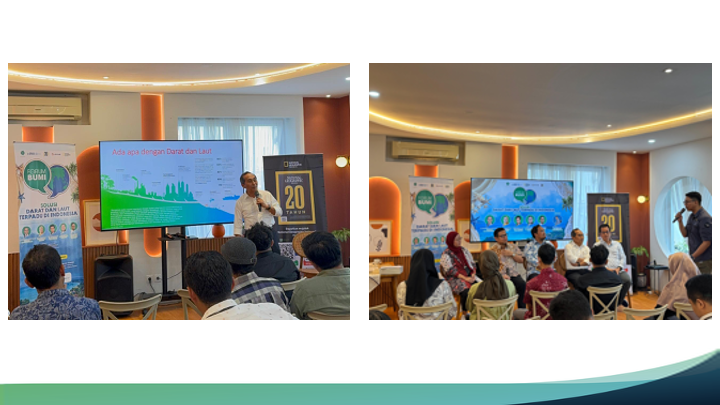
To celebrate World Environment Day, SOLUSI project participated in “Forum Bumi: Solusi Darat dan Laut Terpadu di Indonesia,” to discuss a critical yet often overlooked issue in Indonesia, integrated land and seascape management. This event is a collaboration between Yayasan KEHATI and National Geographic Indonesia. Attended by over 30 people from academia, media, and civil society, the event featured a panel discussion followed by discussion with the moderator and QnA session with participants.
The event invited Prof. Dr. Ir. I Nyoman Suyasa from Politeknik AUP Jakarta, who emphasized that integrated land and seascape management is not about merging physical boundaries, but fostering harmony and cross-sector synergy through environmentally sustainable approaches. Other speakers included Yuliana Wulan (GIZ), Arga Pandiwijaya (CIFOR-ICRAF), Iman Budi (SNV), and Dr. Rony Megawanto (Yayasan KEHATI), who discussed key aspects to support LaS integration:
- A strategic LaS masterplan that aligns with national regulations is key to long-term, sustainable land and marine planning.
- Biodiversity conservation and community involvement ensure environmental efforts are inclusive and lasting.
- Stakeholder capacity building helps create agent of change who can scale up integrated approaches across regions.
- Public-private-community collaboration (PPCP) drives a green-blue economy that protects nature and supports livelihoods.
In line with the spirit of World Environment Day, the event reinforced that environmental protection cannot be achieved in silos. Integrated land and seascape management offers a pathway toward that future—where people and nature thrive together